Selecting an Electronic Design Automation (EDA) platform is one of the most consequential decisions an engineering team will make. Deciding how to choose PCB design software for your engineering team acts as a foundation for your team’s entire workflow, impacting everything from individual productivity and design integrity to long-term scalability and time-to-market. And yet, with a crowded market ranging from free, community-driven tools to high-end enterprise platforms, the selection process can easily lead to “paralysis by analysis.” Choosing the wrong software results in steep re-training costs, difficult data management, and inefficient collaboration.
In this guide, we take a vendor-agnostic approach to the decision. We’ll focus on questions your team needs to answer first about design complexity, team structure, and growth trajectory. Then, we’ll discuss available tools across the EDA landscape, including Cadence’s OrCAD X and Allegro X lines, to illustrate what each level of capability looks like in practice.
Define Your Team’s Technical and Operational Needs
Before evaluating specific features of a PCB design software, you must audit the types of designs your team currently produces and where you expect to be in three to five years. For example, software that handles a simple two-layer sensor node will fail when tasked with a 12-layer high-speed digital board. Consider the following technical requirements:
- Design Complexity: Does the team work with High-Density Interconnect (HDI), rigid-flex, or high-pin-count BGAs?
- Signal Integrity Requirements: Are designs targeting DDR5, PCIe Gen 5, or RF applications that require integrated SI/PI (Signal/Power Integrity) analysis?
- Team Size: Is the team composed of two engineers in the same room or a global department requiring concurrent design capabilities?
Matching EDA Tier to Your Organization
| Small/Medium Businesses (SMB) | Mid-Market | Enterprise | |
|---|---|---|---|
| Primary Use | Core PCB design, low to medium complexity boards | High-speed / High-density / SI-PI focused design | Complex system-scale and multi-board designs |
| Price | Free and open-source options available; entry-level commercial tools start around $500 per seat | Typically $2,000–$10,000 per seat, depending on toolset. Subscription models are available, reducing upfront CapEx | High per-seat enterprise pricing; often site licenses with support and integration costs |
| Scale | Individual or small teams (1–5 engineers), limited collaboration | Team-based design (5–50 engineers), shared libraries, and version control | Large-scale distributed teams (50+ engineers, multi-site collaboration) |
| Functionality | Schematic capture, basic PCB layout, standard manufacturing outputs | Constraint-driven design, SI/PI simulation, HDI, and rigid-flex support | Full system-level design, multi-board support, advanced DFM, ECAD-MCAD integration, PLM/ERP workflows |
| Sourcing Insight | Basic or live component data, depending on the tool | Metadata-driven approved vendor lists | Enterprise PLM/ERP-integrated sourcing |
| Examples | OrCAD X Standard | OrCAD X Professional | Allegro X |
How to Choose PCB Design Software for Your Engineering Team
A professional EDA tool should do more than just place footprints and route traces. A major differentiator in how to choose PCB design software for your engineering team is whether the software uses the “correct-by-construction” methodology, which ensures functional correctness from the start.
Advanced Constraint Management
Modern high-speed design requires specific rules. Look for a platform with a unified Constraint Manager, such as Cadence OrCAD X and Allegro X. This allows hardware engineers to set electrical rules (timing, phase, impedance) at the schematic level that automatically drive the layout process, preventing errors before they occur.
High-Performance Routing
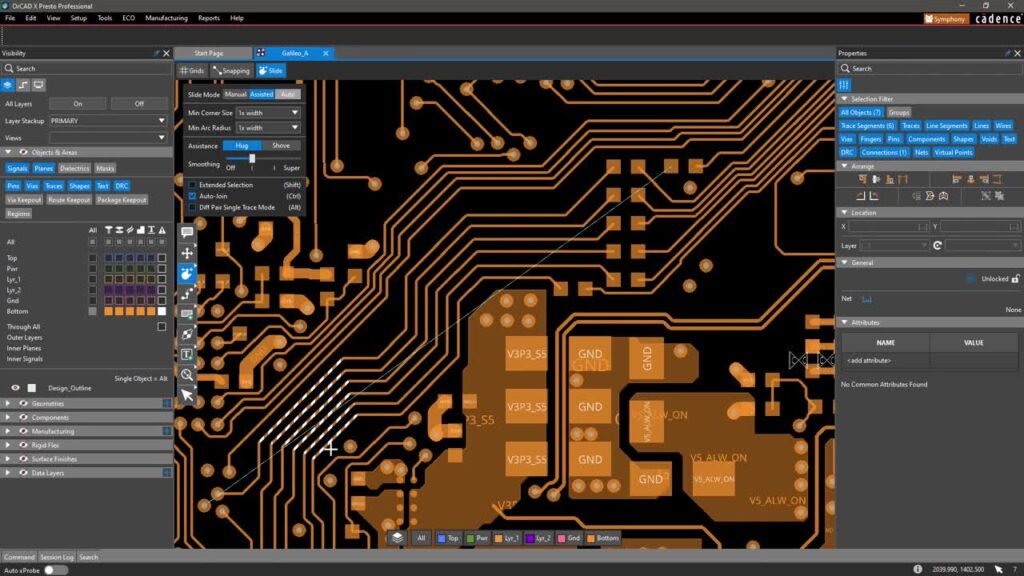
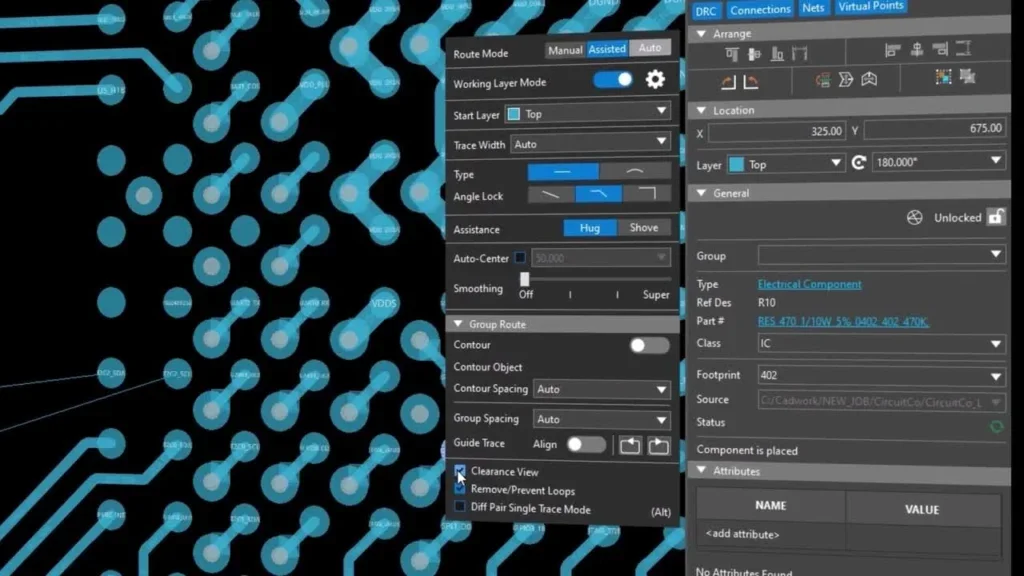
For complex boards, manual routing is often a bottleneck. Evaluate the software’s interactive routing capabilities, including “hug and shove” modes, auto-interactive breakout, and delay-tuning features. These tools significantly reduce the time spent on repetitive routing tasks.
Evaluate Collaboration and Library Management
In a team environment, data management is often the highest hidden cost. If your engineers are manually emailing library parts or saving file versions as “Final_v2_REAL_FINAL.brd,” your workflow is broken.
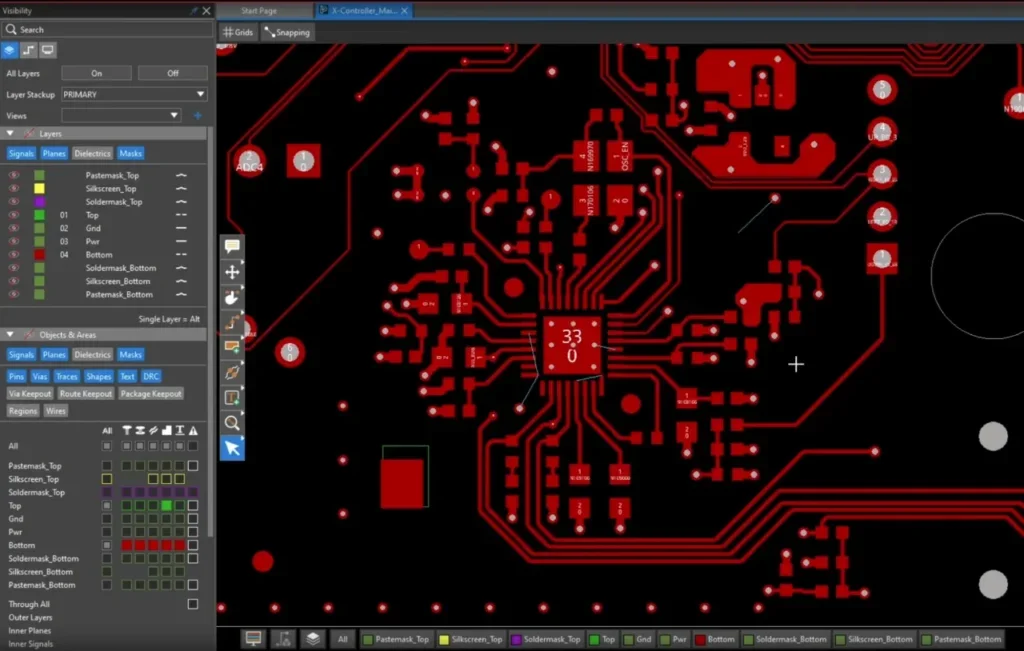
- Cloud-Enabled Workspaces: Professional platforms should offer centralized workspaces that act as a single source of truth. This ensures every team member is working on the latest design version and using verified library parts.
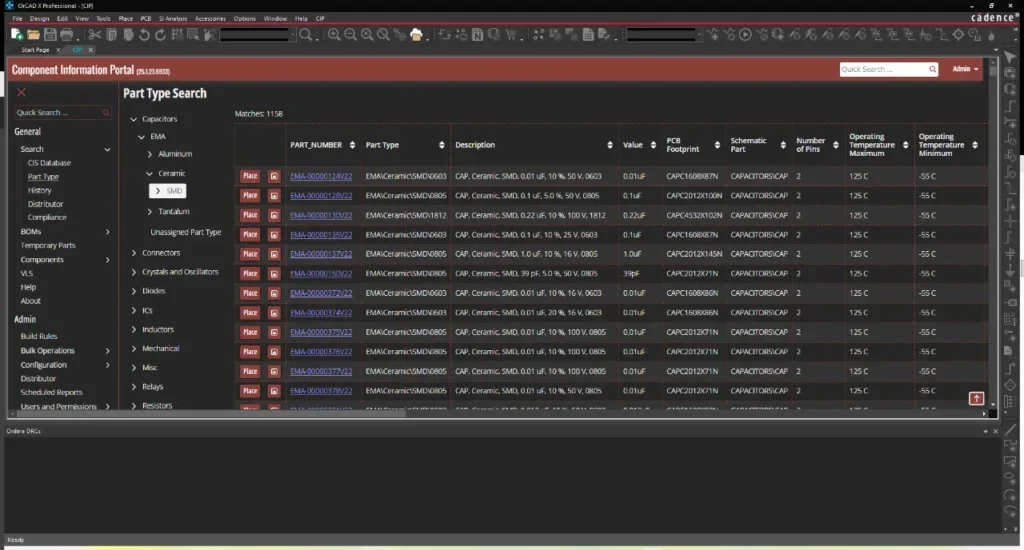
- Library Provenance: An accurate library is the backbone of manufacturability. Tools that integrate with verified providers allow teams to download IPC-compliant footprints and symbols directly, eliminating the risk of manual drafting errors.
Assess Pricing, Scalability, and TCO
The initial purchase price is only one part of the Total Cost of Ownership (TCO). Managers must consider the cost of downtime, maintenance, and the upgrade path.
Scalability
When evaluating scalability, consider not just whether a tool grows with the team, but whether it also avoids vendor lock-in and allows teams to freely mix tools from different vendors without losing collaboration or access to a common library and infrastructure. Many modern EDA ecosystems support neutral interchange formats such as IPC-2581 or ODB++, which make it possible to move designs between tools and vendors while preserving data integrity and reducing dependency on a single platform.
For example, OrCAD X and Allegro X share the same underlying data model, allowing teams to move between tiers without library migration or data translation. This means companies are not restricted to one vendor stack and can mix based on needs without losing the ability to collaborate and work on a common library and infrastructure.
Licensing Models
Determine if your budget favors a Capital Expenditure (CapEx) through perpetual licenses or an Operating Expenditure (OpEx) via subscription models. Subscriptions often provide lower entry costs and guaranteed access to the latest features, such as a variety of useful AI-driven features.
Review Integrations and Support
PCB design does not happen in a vacuum. Your EDA software must speak the language of other departments. This means that engineers not directly working on the electronics for the printed circuit board should easily be able to access, understand, and modify the board if needed, based on their role.
- ECAD-MCAD Collaboration: Look for native integrations with tools like SolidWorks or Autodesk Fusion. Passing 3D data and constraints between environments is important for confirming the PCB fits the enclosure before fabrication.
- Technical Support: When a critical deadline is approaching, and a tool issue arises, community forums are not enough. Evaluate the level of direct technical support and training resources provided by the vendor.
Choosing PCB design software is as much an exercise in understanding the team as it is in understanding the products available. Anchoring the decision in actual design complexity, collaboration needs, and growth trajectory, while staying open to mixing tools across vendors where it makes sense, gives engineers the right foundation for the work ahead.
EMA Design Automation provides the expertise and the full suite of Cadence tools to help your team transition to a more efficient design environment. From initial tool selection to customized training and support, we ensure you have the right foundation for success.
EMA Design Automation is a leading provider of the resources that engineers rely on to accelerate innovation. We provide solutions that include PCB design and analysis packages, custom integration software, engineering expertise, and a comprehensive learning and training academy, enabling you to create more efficiently. For more information on how to choose PCB design software for your engineering team and how we can help you or your team innovate faster, contact us.